
Students often lose Maths marks because of small, repeated errors rather than difficult concepts. A missed negative sign, wrong formula, calculator mistake or failure to check an answer can change an otherwise correct solution.
Understanding common maths mistakes helps students identify patterns and develop better study habits. For SACE students, accuracy and problem-solving are just as important as understanding mathematical concepts.
Why Do Students Make Maths Mistakes?
Common reasons include:
- Misreading questions
- Choosing the wrong formula
- Algebra mistakes
- Calculator errors
- Forgetting units
- Rounding too early
- Rushing
- Not checking answers
The first step is understanding why the mistake happened.
1. Misreading the Question
Students sometimes start calculating before understanding what the question requires.
How to avoid it: Ask:
What information is given? What do I need to find?
Read the entire question before choosing a method.
2. Choosing the Wrong Formula
Knowing formulas is not enough. Students must understand when each formula should be used.
How to avoid it: Identify the mathematical relationship first, then choose the formula that connects the information provided with the required answer.
3. Algebraic Sign Errors
Negative signs are a common source of mistakes, particularly when expanding, simplifying or rearranging equations.
How to avoid it: Write important steps clearly and check positive and negative signs before continuing.
4. Incorrectly Expanding Brackets
Students may forget to multiply every term inside brackets.
For example:
[
3(x+4)=3x+12
]
How to avoid it: Write each multiplication step rather than completing several operations mentally.
5. Rearranging Equations Incorrectly
Errors can occur when students try to isolate a variable too quickly.
How to avoid it: Work through one step at a time and substitute the answer back into the original equation when possible.
6. Rounding Too Early
Rounding intermediate values can affect the final answer.
Better approach: Keep extra decimal places during calculations and round only at the appropriate stage.
7. Forgetting Units
Answers may require units such as metres, kilograms, seconds or dollars.
How to avoid it: Ask, “What does this number represent?” before finishing.
8. Confusing Area, Perimeter and Volume
Remember:
- Perimeter: distance around a shape
- Area: space inside a 2D shape
- Volume: space inside a 3D object
Identify what the question is measuring before selecting a formula.
9. Misusing Percentages
Percentage increase, decrease and percentage change are different calculations.
How to avoid it: Read the wording carefully and determine exactly what percentage is being requested.
10. Calculator Entry Errors
Incorrect brackets, negative values, powers or decimal points can produce incorrect results.
How to avoid it: Write the expression first, enter it carefully and check whether the answer makes sense.
11. Relying Too Much on the Calculator
A calculator should support mathematical reasoning, not replace it.
Ask:
What am I calculating?
Why am I calculating it?
What does the answer mean?
12. Not Showing Working
Trying to complete everything mentally can make mistakes difficult to identify.
Better approach: Show the important steps clearly so you can review your method.
13. Skipping the Answer Check
Before moving to the next question, quickly check for:
- Sign errors
- Wrong units
- Calculator mistakes
- Incorrect substitutions
- Unrealistic answers
Ask: Does my answer make sense?
14. Struggling With Graphs
Students may confuse gradients, intercepts, coordinates and variables.
Before reading a graph, identify the axes, units and relationship being represented.
15. Using the Wrong Trigonometric Relationship
Trigonometry mistakes often happen when students select the wrong relationship.
Better approach: Draw a diagram, label the known values and identify the unknown before choosing the appropriate method.
16. Forgetting Domain Restrictions
Some mathematical solutions may not be valid within the original problem.
Always ask:
Are all of these solutions suitable for the context?
This is important in equations, functions and modelling.
17. Memorising Without Understanding
Memorising procedures can make unfamiliar questions difficult.
After learning a method, ask:
Why does it work?
When should I use it?
Understanding the method makes it easier to apply in different situations.
18. Practising Only Easy Questions
Students should progress from:
Basic → Standard → Application → Challenging → Unfamiliar
This prepares students for assessment questions that require more than repeating classroom examples.
19. Not Reviewing Mistakes
Don’t simply check the correct answer and move on.
Ask:
What went wrong?
Why did it happen?
What will I do differently next time?
A simple mistake log can make revision more effective.
20. Leaving Revision Until the Last Minute
Maths skills develop through regular practice.
A weekly routine can include reviewing concepts, completing questions, revisiting weak areas and practising under timed conditions.
How to Reduce Common Maths Mistakes
Before submitting an answer, ask:
Did I understand the question?
Did I choose the right method?
Did I check my calculations?
Did I use my calculator correctly?
Did I include the required units?
Does my answer make sense?
A consistent checking routine can prevent many avoidable errors.
How Maths Tutors in Adelaide Can Help
Some students know they are making mistakes but cannot identify why.
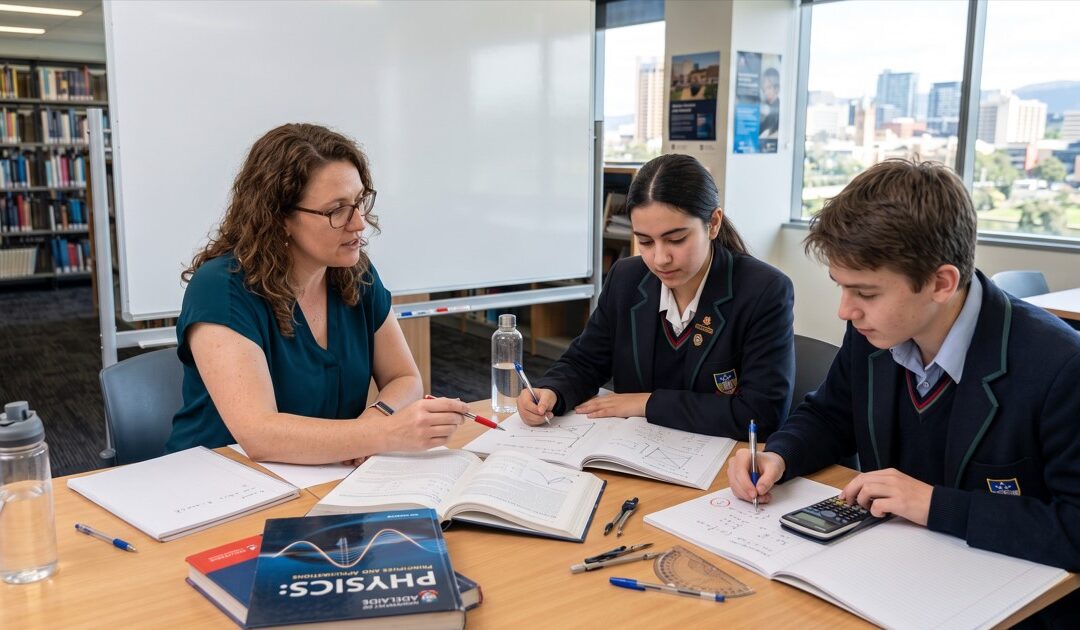
A Maths Tutor in Adelaide can review incorrect solutions and identify recurring problems.
A student may understand the concept but struggle with algebra, question interpretation, formulas or unfamiliar applications.
Once the problem is identified, tutoring can focus on that specific weakness.
SACE Maths Students: Focus on Accuracy
For SACE students, reducing common maths mistakes should be part of regular preparation.
Focus on:
- Applying concepts
- Solving unfamiliar problems
- Showing working
- Using technology accurately
- Checking answers
- Reviewing mistakes
The goal is to recognise recurring errors and learn how to avoid them.
A Better Way to Study Mathematics
Use this simple study process:
Review → Practise → Challenge → Analyse → Correct → Revisit
This approach helps students learn from mistakes rather than simply complete more questions.
Frequently Asked Questions
What are common maths mistakes?
Misreading questions, choosing incorrect formulas, algebra errors, calculator mistakes, premature rounding, missing units and failing to check answers are common examples.
How can I make fewer Maths mistakes?
Read carefully, show your working, check calculations and review previous mistakes regularly.
Can a Maths tutor help?
Yes. A tutor can identify recurring problems and help students develop better solving and checking strategies.
Are mistakes normal?
Yes. Mistakes are part of learning. The important thing is understanding why they happened and avoiding the same pattern next time.
Improve Your Maths With a Strategic Approach
Common maths mistakes can affect results when they happen repeatedly. Students can improve by strengthening fundamentals, practising different question types and analysing their errors.
Advanced Education provides Maths tutoring in Adelaide tailored to individual learning needs, mathematical skills and academic goals.
Contact Advanced Education to discuss a learning plan tailored to your child’s goals.