
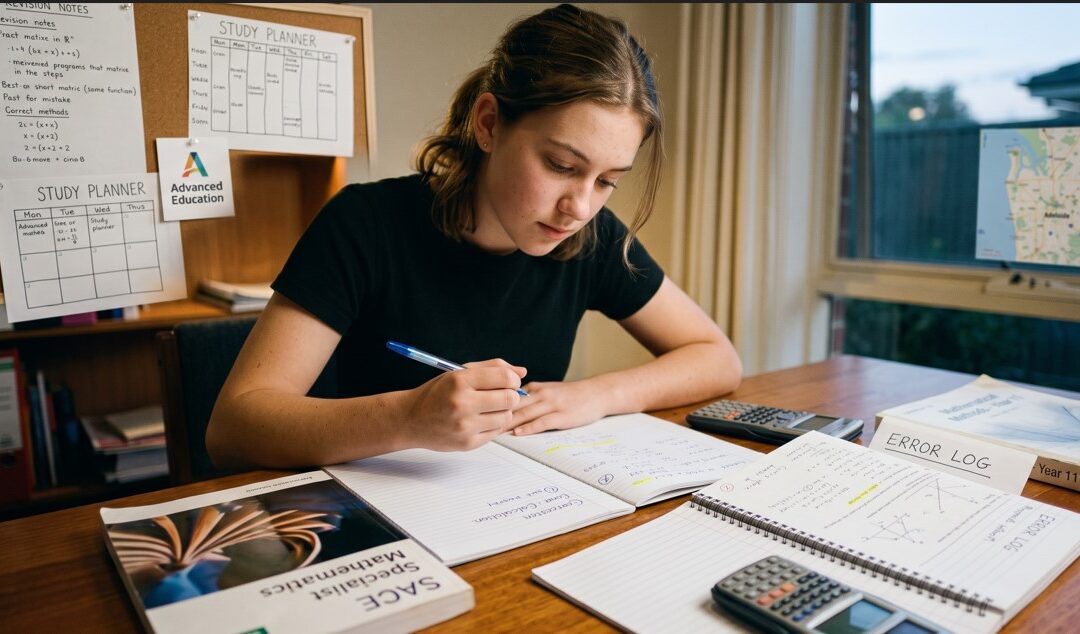
Preparing for SACE Mathematics is about far more than completing a stack of practice questions before an assessment. As students progress through senior secondary mathematics, the concepts become more interconnected, the problems become less predictable, and assessments increasingly require students to apply mathematical knowledge rather than simply recall procedures.
For students studying SACE Mathematical Methods or Specialist Mathematics, effective preparation starts well before examination season.
The strongest students typically develop a consistent system: they build secure foundations, understand concepts deeply, practise a wide range of problems, analyse mistakes and learn how to communicate mathematical reasoning clearly.
For parents searching for a maths tutor Adelaide families can rely on, understanding this preparation process is equally important. The right support should complement classroom learning, identify individual gaps and help students become more confident and independent mathematicians.
Understand What SACE Maths Actually Requires
Before developing a study plan, students need to understand the nature of their subject.
SACE Stage 2 Mathematical Methods develops increasingly sophisticated understanding of calculus and statistics, including functions, derivatives, integrals, mathematical modelling and statistical analysis.
Specialist Mathematics goes further into advanced mathematical thinking, including rigorous mathematical arguments and proofs, mathematical modelling, functions and calculus. SACE identifies it as a pathway relevant to areas including mathematical sciences, engineering, computer science and physical sciences.
This means preparation cannot rely entirely on memorising formulas.
Students need to be able to recognise mathematical structures, select appropriate methods, connect concepts and apply their knowledge to problems they may not have seen before.
Build Your Foundations Before Tackling Advanced Topics
One of the biggest mistakes students make is trying to move forward while leaving fundamental weaknesses unresolved.
Senior mathematics is cumulative. A weakness in algebra can affect functions. Difficulties with functions can make calculus harder. Weak trigonometry can create problems in later applications.
Before moving into intensive assessment preparation, students should be comfortable with core skills such as:
- Algebraic manipulation
- Equations and inequalities
- Functions and graphs
- Indices and logarithms
- Trigonometry
- Coordinate geometry
- Mathematical notation
- Basic calculus concepts
- Problem-solving techniques
This does not mean revising an entire mathematics syllabus from the beginning.
Instead, students should identify the specific foundational skills affecting their current performance and address those weaknesses systematically.
Create a SACE Maths Study Plan Early
Effective preparation should not begin immediately before an examination.
A strong study plan distributes learning across the term and gradually increases the level of independent problem-solving.
A practical approach can include:
Concept learning: Understand the material being taught at school.
Targeted practice: Complete questions designed around that concept.
Mixed practice: Combine different topics so the student must identify the appropriate method.
Application: Solve unfamiliar or multi-step problems.
Assessment practice: Complete questions under realistic time conditions.
Review: Analyse mistakes and revisit areas of weakness.
This approach reduces last-minute pressure and gives students multiple opportunities to strengthen their understanding.
Don’t Just Memorise Formulas
Formula knowledge is important, but memorisation alone is rarely enough for high-level mathematical performance.
Students should understand what a formula means, why it works and when it should be applied.
For example, a student may remember a differentiation rule but still struggle when an assessment presents a problem where the appropriate mathematical technique is not immediately obvious.
Strong preparation therefore involves asking:
- What is this concept describing?
- What information does the question provide?
- What is the question actually asking?
- Which mathematical relationship applies?
- Why is this method appropriate?
- Does my answer make sense?
This shift from “Which formula do I use?” to “What mathematical idea is this problem testing?” can significantly improve problem-solving ability.
Practise Unfamiliar Problems
Students often feel confident when they practise questions that closely resemble examples from class.
The real test comes when the structure changes.
An unfamiliar question may combine multiple concepts, present information differently or require students to determine the appropriate method independently.
This is why effective SACE preparation should include progressively more challenging questions.
Students should practise moving from:
Worked example → Similar question → Mixed question → Unfamiliar problem → Timed assessment
The objective is to make mathematical thinking more flexible.
Learn From Every Mistake
One of the most valuable resources a student has is their own assessment history.
Instead of simply checking an incorrect answer and moving on, students should determine why they made the mistake.
Was it:
- A conceptual misunderstanding?
- An algebraic error?
- A calculation mistake?
- Incorrect formula selection?
- Misinterpretation of the question?
- Poor time management?
- Incomplete working?
- Difficulty applying knowledge independently?
Keeping an error log can help students identify recurring patterns.
For example, if a student repeatedly loses marks through algebraic simplification, spending additional time on advanced calculus questions may not address the real problem.
The goal is targeted improvement.
Prepare for Both School Assessment and the Examination
SACE preparation should account for the full assessment journey.
For Stage 2 Mathematical Methods, SACE currently lists school assessment as 70% and the external examination as 30%. The Mathematical Methods examination is externally assessed.
Specialist Mathematics also has school-based and external assessment components, with the Stage 2 examination accounting for 30% of the subject result.
Students therefore need to prepare for more than one assessment environment.
School-based tasks require consistent performance throughout the year, while examination preparation requires students to work efficiently and independently under time constraints.
Develop Examination Technique
Knowing mathematics and performing well in an examination are related but different skills.
Students should practise:
- Reading questions carefully
- Identifying exactly what is required
- Allocating time effectively
- Showing appropriate working
- Using mathematical notation correctly
- Checking calculations
- Reviewing answers
- Returning to difficult questions strategically
Timed practice should become part of preparation as the examination approaches.
Students can begin with individual timed questions before progressing to complete practice papers under realistic conditions.
Use Past Papers Strategically
Past examination papers can be valuable preparation tools, but they should not simply be completed repeatedly without analysis.
A better process is:
Attempt → Mark → Diagnose → Correct → Reattempt
After completing a paper, students should examine every lost mark.
Ask:
- Did I understand the concept?
- Did I choose the correct method?
- Did I make a preventable calculation error?
- Did I run out of time?
- Did I misunderstand the wording?
- Could I have communicated my solution more clearly?
The paper then becomes more than an assessment it becomes a diagnostic tool.
SACE provides past examination resources for both Mathematical Methods and Specialist Mathematics, which students can use as part of structured preparation.
Know the Difference Between Methods and Specialist Mathematics
Students preparing for SACE Maths should also understand the expectations of their particular subject.
Mathematical Methods develops advanced understanding of calculus, statistics, functions and mathematical modelling.
Specialist Mathematics is designed to deepen mathematical knowledge and develop more rigorous mathematical reasoning, including proof and modelling. SACE also indicates that Specialist Mathematics is designed to be studied in conjunction with Mathematical Methods.
This distinction matters when planning tutoring and revision.
A student studying Mathematical Methods may need targeted support with calculus, functions, statistics and modelling, while a Specialist Mathematics student may require additional emphasis on abstract reasoning, proof, advanced problem-solving and connecting multiple mathematical concepts.
When Should Students Consider a Maths Tutor?
A maths tutor is not only for students who are failing.
Students may seek personalised tutoring because they:
- Have fallen behind in a particular topic
- Want to strengthen mathematical foundations
- Need additional explanation outside classroom hours
- Are preparing for major assessments
- Want to become more confident with unfamiliar problems
- Need help developing better study habits
- Are aiming for stronger academic performance
- Are preparing for Mathematical Methods or Specialist Mathematics
The value of tutoring comes from targeted support rather than simply adding more hours of study.
A good tutor should help identify what the student needs and adapt the learning process accordingly.
Choosing a Maths Tutor in Adelaide
When looking for a maths tutor in Adelaide, parents should consider more than availability.
Look for a tutor or tutoring provider with:
- Strong knowledge of the SACE curriculum
- Experience with senior secondary mathematics
- Understanding of Mathematical Methods and Specialist Mathematics
- Ability to explain complex concepts clearly
- Strong problem-solving skills
- A personalised teaching approach
- Regular feedback and progress monitoring
- Experience preparing students for assessments
The relationship between student and tutor also matters.
Students should feel comfortable asking questions, admitting when they do not understand something and attempting challenging problems without feeling discouraged.
How Advanced Education Supports SACE Maths Students
Advanced Education provides personalised mathematics tutoring for students across Adelaide, including SACE students studying Mathematical Methods and Specialist Mathematics.
The service currently offers private maths tuition online and in person, as well as SACE-focused group classes for senior mathematics subjects.
Lessons can be tailored around a student’s current knowledge, school curriculum, learning pace and academic objectives.
Rather than applying one standard program to every student, personalised tutoring can focus on the areas where additional support will have the greatest value.
Advanced Education’s private tutoring approach is designed around individualised attention and tailored learning experiences, with tutors supporting students according to their specific needs and learning styles.
Build a Better Relationship With Mathematics
The ultimate goal of SACE Maths preparation should not be to memorise enough material to survive one examination.
Students who develop strong mathematical thinking can carry those skills into university study and future careers.
They learn to:
- Approach unfamiliar problems logically
- Break complex questions into manageable steps
- Recognise relationships between concepts
- Check whether answers are reasonable
- Communicate mathematical reasoning
- Learn from mistakes
- Work independently
These skills become increasingly valuable as students move beyond secondary education.
A High-Performance SACE Maths Preparation Framework
For students who want a simple framework to follow, use:
Learn → Practise → Apply → Analyse → Refine → Test
Learn
Understand the mathematical concept rather than memorising a procedure.
Practise
Build fluency through carefully selected questions.
Apply
Use the concept in unfamiliar and multi-step problems.
Analyse
Review mistakes and identify the reason behind each lost mark.
Refine
Return to weak areas and strengthen the underlying skill.
Test
Complete timed assessment-style questions to measure progress.
Repeated consistently, this process can create a much stronger foundation for SACE Mathematics.
Frequently Asked Questions
How early should I start preparing for SACE Maths?
Preparation should begin throughout the school year rather than being left until examination season. Consistent weekly practice allows students to address gaps before they become larger problems.
Is a maths tutor necessary for SACE?
Not every student needs tutoring. However, personalised support can be valuable for students who need additional explanation, targeted practice, assessment preparation or help with challenging concepts.
Can a maths tutor help with Mathematical Methods?
Yes. A suitably experienced tutor can provide targeted support with Mathematical Methods topics, problem-solving, assessment preparation and examination technique.
Can a tutor help with Specialist Mathematics?
Yes. Students can receive personalised support with advanced mathematical concepts, problem-solving and the rigorous reasoning expected in Specialist Mathematics.
What makes a good SACE maths tutor?
A strong SACE maths tutor should understand the curriculum, explain complex ideas clearly, adapt lessons to the student’s needs and help the student develop independent mathematical reasoning rather than simply providing answers.
Prepare With Purpose, Not Pressure
SACE Mathematics rewards students who develop understanding consistently over time.
The most effective preparation combines strong foundations, conceptual understanding, deliberate practice, unfamiliar problem-solving, careful error analysis and realistic assessment practice.
For students who need additional support, working with an experienced maths tutor in Adelaide can provide a structured environment in which difficult concepts can be revisited, questions can be explored in depth and learning strategies can be adapted to individual needs.
If your child is preparing for SACE Mathematical Methods, Specialist Mathematics or another senior mathematics subject, explore Advanced Education’s Maths Tutor Adelaide program to learn more about personalised online and in-person mathematics tutoring.
Contact Advanced Education to discuss a learning plan tailored to your child’s SACE Maths goals.